Detection of UHE Cosmic Rays
The techniques by which cosmic rays in a given energy range are detected depend critically on the rate of arrival. In the energy spectrum below (which you already saw in the section on Ultra-High Energy Cosmic Rays), you see that in the energy range of 1011-1012 eV, the flux of cosmic rays is roughly 1 particle per square meter (one square meter is roughly 10 square feet). This rate is high enough to allow direct detection.
The atmosphere absorbs most of the cosmic rays, as was demonstrated by Hess's original experiments. Radiation detected at ground level are actually secondary particles produced from interactions between primary cosmic rays and the air. To measure the primary cosmic rays directly, the detection equipment must be placed above the atmosphere. This is accomplished usually by carrying the instrument aboard high-altitude balloons flying at above 100,000 feet, on Earth-orbit satellites, or in the future aboard the International Space Station (ISS). An example of a detector schduled for deployment on the ISS is the Alpha Magnetic Spectrometer (AMS), which is designed to search for nuclear antimatter in cosmic rays.
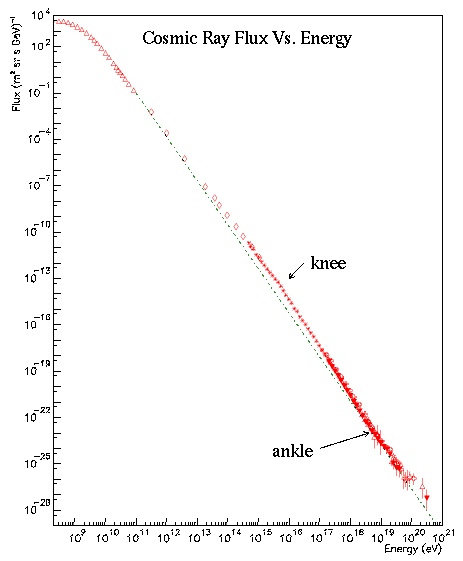
At above 1015-1016 eV, the flux of cosmic rays drops to below one particle per square meter per year. This rate makes direct measurements impractical, as it would require flying very large detectors in order to collect sufficient number of particles. A different method is required.
Over the last 70 years, physicists have studied cosmic rays with energies in excess of ~1014 eV by using the Earth's atmosphere itself as part of the detection equipment .This technique takes advantage of the fact that interaction between high-energy cosmic rays and the air produces a correlated cascade of secondary particles. The process begins with the collision of the primary cosmic ray with a nucleus near the top of the atmosphere. This first collision typically produces more than 50 secondary particles, a majority of which are pi-mesons* (usually referred to as pions).
Pions come in three different flavors: positively charged, negatively charged, and neutral. All pions are unstable, but the charged pions are relatively long-lived and will most probably collide with another nucleus before decaying. The subsequent collisions are similar in nature to the primary collision. This process then leads to a cascade of particles which is referred to as a "hadronic shower".
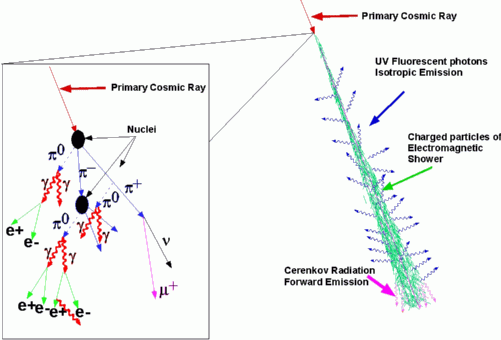
One third of the pions produced are neutral. The neutral pions are very short-lived and will almost all decay into a pair of photons (gamma rays) before interacting with nuclei in the atmosphere. The photons interact with the nuclei in the air to produce electron-positron pairs, which in turn will produce photons via the "bremsstrahlung" process. This cascading process leads to the formation of an "electromagnetic shower". The hadronic shower istelf is continuously producing neutral pions and thus initiating secondary electromagnetic showers along its path.
While high-energy cosmic rays are believed to consist mostly of charged nuclei. Gamma rays have been observed with energies as high as ~1012 eV. In the case of a gamma-ray primary particle, the particle shower produced would be purely electromagnetic. Generically, both types of cascades are called "extensive air showers" (EAS).
 Extensive air showers were discovered in the 1930's by French physicist Pierre Victor Auger. In addition to his contributions to the field of cosmic rays, Pierre Auger was most well known for his discovery in the 1920's of a spontaneous process by which an atom with a vacancy in the K-shell achieves a more stable state by the emission of an electron instead of an X-ray photon, commonly known as the Auger Effect. This process forms the basis for the technique of Auger Electron Spectroscopy developed in the 1960's for characterizing surface properties of materials. Pierre Auger held the position of the Head of the Natural Science Sector at UNESCO during the years 1948-1959. Between 1962-1967, he served as Director General for the European Space Research Organization, the forerunner of the European Space Agency (ESA).
As an EAS develops into the atmosphere, more and more particles are produced. A small fraction of the kinetic energy of the primary particle is converted into mass energy. The remaining kinetic energy is then distributed over the shower. The process of multiplication continues until the average energy of the shower particles is insufficient to produce more particles in subsequent collisions. This point of the EAS development is called the "shower maximum". Beyond the maximum, the shower particles are gradually absorbed with an attenuation length of ~200 g/cm2 (rigorously this is a measure of the depth of material penetrated by the shower, which will be explained below).
* For an introduction to elementary particles, please visit this page by NOVAElementary Particles. Properties of elementary particles can also be found at the web-site of the Particle Data Group.
Two properties of the shower maximum are important to note. First, at maximum, an EAS typically contains ~1-1.6 particles for every GeV (109 eV) of energy carried by the primary cosmic ray. Second, the average "slant depth"at which the shower maximum occurs, varies logarithmically with the energy of the primary cosmic ray.
The "slant depth" refers to the amount of materials penetrated by the shower at a given point in its development, and is customarily denoted by the symbol "X". The value of X is calculated by intergating the density of air from the point of entry of the air shower at the top of the atmosphere, along the trajectory of the shower, to the point in question. Hence X has units given as desnity (g/cm3) multiplied by distance (cm). An air shower traveling along an exactly vertical, downward trajectory traverses ~1,000 g/cm2 in reaching sea-level. This value of 1,000 g/cm2 can also be interpreted as an atmospheric pressure. Obviously, an inclined shower will traverse more than 1,000 g/cm2 to reach sea-level.
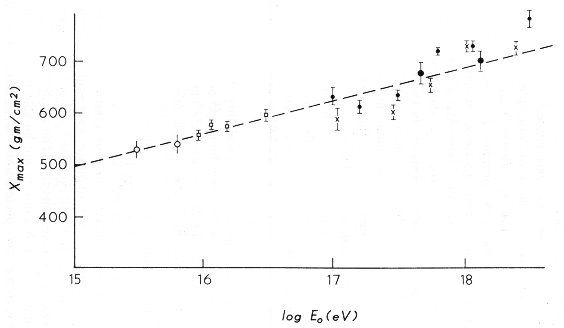
Following the above convention, the depth of shower maximum is denoted "Xmax". The figure above shows a compilation of measured average Xmax as a function of energy [1-3]. With a value of about 500 g/cm2 at 1015 eV, the average Xmax for cosmic ray showers increases by 60-70 g/cm2 for every decade of energy.
The measured value of Xmax can also be used a sa measure of the composition of the primary cosmic ray. Hadronic interaction length in air for protons is about 70 g/cm2, and shorter for heavier nuclei. This means EAS induced by heavier elements tends to suffer its first interaction higher in the atmosphere, and hence have shallower Xmax than showers of the same energy initiated by a lighter element.
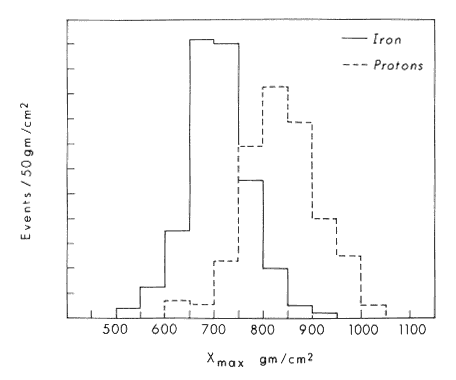
The figure above shows simulated Xmax distributions for air showers induced by iron nuclei and protons with energies of 1019 eV. The two distributions are separated, but each shows siginificant fluctuations which makes even-by-event discrimmination very difficult. Instead, the composition study is restricted to a statistical study of average Xmax over large number of events.
Various hadronic shower models tend to predict significantly different absolute values for average Xmax. This makes direct comparison of measured Xmax to theoretical predictions somewhat problematic as a means of studying composition. However, nearly all the models predict (a) the same slope dXmax/dLog10E ~ 55 g/cm2 for any single element, and (b) roughly the same separation in Xmax between heavier and lighter elements. A deviation in the measured slope dXmax/dLog10E, referred to as the "Elongation Rate", from the canonical single-component value would be a clear indication of an evolution in the composition mix with energy.
For air showers with energies in excess of 1015 eV, the shower maximum penetrates to half the veritcal atmospheric depth or more. There is also sufficient number of particles in the cascade such that the remnant of the shower can be detected as a correlated event by an array of individual particle detectors on the ground. The threshold (the lowest energy detectable by an instrument) of such a "Ground Array" depends on the altitude of the array. Typically it is difficult to measure cosmic rays with energies below 1014 eV with ground arrays.
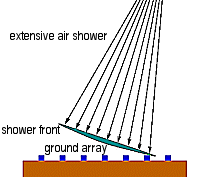 The figure to the right shows the schematic of a ground array. Each station of the array samples the density of particles in its neighborhood of the shower. The footprint of air showers typically extends hundreds of meters. The particles in the air shower arrive in the form of a thin pancake traveling at essentially the speed of light. By measuring the time of arrival of the shower front at the individual stations, the direction of the primary cosmic rays can be calculated to about one degree accuracy. Conventionally, the energy of the shower is deduced from r(600), the desnity measured at 600 meters from the core of the shower at ground level. This density was chosen because it was the quantity which showed least amount of variations between different shower models.
An early example of a ground array is the Haverah Park array operated by University of Leeds between 1967-1987. A more recent experiment is the Akeno Giant Air Shower Array (AGASA) operated by University of Tokyo. When coupled with an underground muon array, it is also possible to measure the composition of the primary particle with a ground array. An example of such a combination used to search for very-high energy gamma rays was the CASA-MIA array.
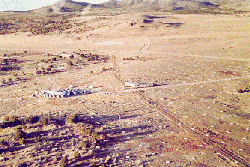 CASA-MIA, depicted in this photograph, was operated between 1989-1997 at the U.S. Army Dugway Proving Ground. It is commonly agreed in the astrophysics community that CASA the definitive search for very-high energy gamma ray sources with energies above ~1014 eV. Their results effectively put to rest the controversy in the 1980's over reports of gamma ray detections from Cygnus X-3 and Hercules X-1.
Ground arrays sample the lateral density profile of the shower as it hits ground. No direct information is obtained for the longitudinal development of the shower. In particular, there is no measurement of Xmax. One way to supplement a ground array is to install a muon array. Another way is to implement an air Cerenkov array with the gorund array.
The particles in a typical air shower are all traveling just below the speed of light in vacuum. In air, however, they are actually traveling faster than the speed of the light in the medium. The result is that they emit light, called Cerekov radiation, analogous to the sonic boom of a supersonic aircraft. As shown in the top figure of this article, the Cerenkov light is beamed in the forward direction of the air shower and can be measured with optical detectors. Two examples of this sort of detectors are the Dual Imaging Cerenkov Experiment (DICE) and the Broad LAteral Non-imaging Cerenkov Array (BLANCA). Both of these were operated with the CASA-MIA array. DICE was an imaging detector similar in design to the High-Resolution Fly's Eye Experiment, and views the shower maximum directly. BLANCA measures the lateral profile of the Cerenkov light and infers Xmax from this data. More information can be found from the BLANCA home page (at The InterNet Archive).
Air showers initiated by gamma rays with energies in the ~1012 eV (TeV) range can also be detected and measured by their forward Cerenkov beam. In the TeV range, the flux of gammar rays are sufficiently low that satellite and baloon-based experiments are unable to measure a significant rate. Ground based telescopes have been the workhorse of TeV gamma ray detection. The Cerenkov light is imaged on to an array of pixels, and photon showers are distinguished from hadron showers by the smoothness of the image (hadron-induced showers contain many sub-showers resulting in a ragged image). The first detector to take advantage of this technique was the Whipple Telescope, located in Arizona. Another experiment using the air Cerenkov technique is the Telescope Array (TA) pictures to the right.
The TA detectors were operated by University of Tokyo at the U.S. Army Dugway Proving Ground between 1996 and 1999. As a vairation on this theme, the STACEE and CELESTE experiments have converted old solar concentrator power stations into large VHE gamma ray detectors.
- Baltrusaitis, R. M. et al., Proc. 20th ICRC, Mowscow, USSR, Vol. 1, 394 (1987).
- Aliev, N. et al., Proc. 19th ICRC, La Jolla U.S.A., Vol. 4, 195 (1985).
- Fomin, Yu. A. et al., Proc. 20th ICRC, Mowscow, USSR, Vol. 6,110 (1987).