UTAH SET NEUTRINO TRAP IN PARK CITY 'DIGGINGS'
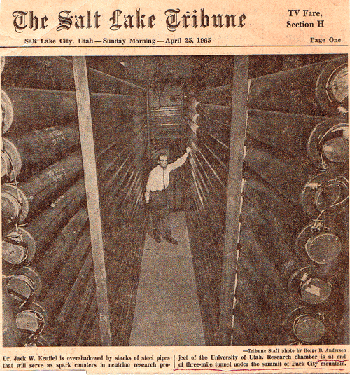
Nearly half a million dollars provided by the National Science Foundation will help a pair of the University of Utah physicists in their effort to trip a ghostly cosmic ray with a 2,000-ton trap in a Park City mine.
DR. A. RAY Olpin, U. of U. president, announced a giant of $475,000 to be used by Dr. Jack W. Keufeel and Dr. R. O. Stenerson for research entitled “Detector for Cosmic Ray Neutrinos.”
A third physicist, Dr. H. E. Bergeson, and 10 graduate assistants will join the project after it gets under way.
THEY’LL BUILD a trap of 360 “sparks counters” arranged between four deep, narrow reinforced concrete water tanks known as Cerenkov detectors and buffered by barite-impregnated high-density concrete blocks.
The sparks counters are oversize Geiger counters of thin walled six-inch diameter steel pipe 33 feet long. They’ll be placed in nine banks of 40 pipes each, stacked horizontally.
THIS HUGE neutrino trap will be placed in a 48,000-cubic-foot underground excavation with a ground cover of at least 2,000 feet.
Dr. Keuffel is negotiating with the owners of United Park City Mines for a place in the mine which is to be made a part of the tourist attractions of Treasure Mountain.
“WITH A balcony above the detector, lights can be arranged so that when a ray pierces the area and courses through the detector, its path can be followed,” Dr. Keuffel said.
Actually, however it is unlikely that the course of a neutrino would be followed.
A neutrino is a bit of cosmic nonenergy – that is, when an atom is broken down, it gives off a neutron and protons. When a neutron collides with other matter, the resultant debris includes neutrinos – but neutrinos have no weight and no electrical charge.
“THEY ARE the nearest thing to nothing that we know of,” Dr. Keuffel said.
They can pass through the entire earth without effect. They are ghostly and elusive. Apparently they carry the disappearing energy” reported in some nuclear reactions.
SINCE IT IS weightless and has no charge, its incredibly rare collisions with matter are strictly by chance. But such a collision – or passage through an unstable charge field of another particle of matter – results in creation of a muron and another neutrino.
While neutrinos may go completely through the earth, other particles will be stopped in the 2,000 feet of overburden atop the mine, thus simplifying identification of a neutrino, Dr. Keuffel believes.
“WE ARE making the detector large enough to examine enough interactions in a reasonably short time to be meaningful,” he said.
What will they do with the results?
RUN THEM through a computer and put them on tape for future use, when and if science ever finds a use for neutrinos.
Right now no on can conceive of a value for them.